Senior Frontend Architect, 10+ years building production Next.js applications. Contentful Certified Professional (2024). Specializes in React Server Components, headless commerce, and Core Web Vitals engineering.
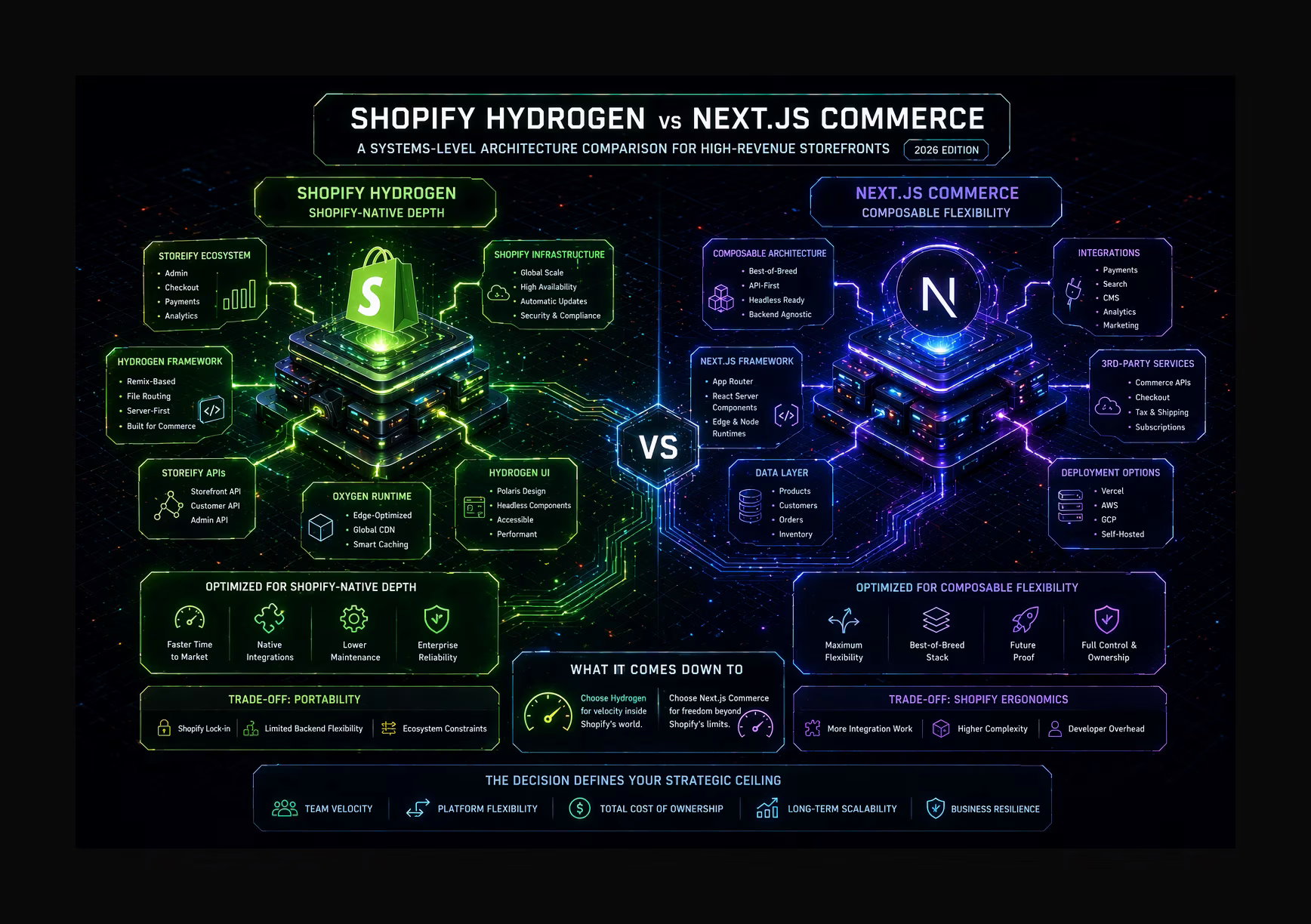
Two React-based architectural patterns now dominate headless Shopify development: Shopify Hydrogen - an opinionated, Shopify-native framework built on Remix (React Router v7), deployed exclusively on Oxygen (Shopify's Cloudflare Workers edge platform) - and Next.js Commerce, Vercel's composable reference implementation using Next.js App Router with React Server Components, deployable on any Node.js host.
I compare them across six dimensions: runtime and deployment model, data layer design, caching strategy, CrUX performance field data, developer experience, and total cost of ownership including lock-in risk. At the end: a practical decision framework based on real team and business situations.
Part I - The Headless Commerce Architecture Landscape
The headless commerce paradigm decouples the frontend presentation layer from the commerce backend - catalog, cart, checkout, inventory, and customer data. The frontend consumes commerce primitives through APIs rather than rendering platform-controlled templates.
This architectural separation delivers two strategic outcomes: (1) full engineering control over frontend performance and user experience, independent of the commerce platform's native rendering constraints; and (2) freedom to compose best-of-breed services - Algolia for search, Nosto for personalization, Yotpo for reviews - independent of the platform's integrated feature set. The tradeoff is engineering cost: a headless frontend requires explicit implementation of features that a coupled storefront (Shopify Liquid, Magento themes) provides by default.
Two schools of thought have emerged within the Shopify headless ecosystem. Hydrogen bets that deep native integration with Shopify's APIs, analytics, and B2B primitives gives you the best long-term productivity if you're committed to Shopify. Next.js Commerce bets that backend-agnostic composition and portability give you better long-term flexibility if your commerce strategy might evolve.
The key thing to know upfront: both frameworks, correctly implemented, clear the Core Web Vitals 'Good' thresholds. The performance gap is real but not the deciding factor. This is a strategic architecture choice about coupling, deployment topology, and long-term platform ownership - not a performance optimization.
Part II - The Shopify Hydrogen Architecture
Hydrogen's technical architecture rests on three co-designed pillars: the Remix (React Router v7) application framework, the Oxygen edge compute runtime, and Shopify's first-party API client library suite.
2.1 - Remix Foundation: The Loader/Action Model
Hydrogen 2.0 (GA January 2024) replaced the custom Hydrogen 1.x React framework with Remix as the application foundation - a decision that unified Hydrogen with the broader Remix ecosystem and eliminated Hydrogen's bespoke streaming primitives in favor of Remix's battle-tested loader/action model. Remix (now React Router v7 as of February 2025) implements a server-centric request/response cycle with two primary constructs.
- loader functions execute on the server before the route component renders. They receive the HTTP request (including URL parameters, cookies, headers) and return typed data via a
json()ordefer()response. Thedefer()primitive enables Suspense-based streaming: critical data resolves synchronously, while deferred data streams in parallel, injected into Suspense boundaries as Promises resolve. - action functions handle non-GET requests (form submissions, mutations). They execute on the server, mutate state (add to cart, update quantity), and return a redirect or data response. This eliminates the client-side fetch/state-sync pattern for the majority of commerce interactions.
- Nested routing allows route-level data loading to coexist: a
/products/:handleroute loads product data independently from its parent/productslayout's collection data, with each boundary independently showing skeleton states.
The Remix model is architecturally closest to the traditional server-rendered request/response web. Critically, there is no static generation equivalent in Hydrogen - every route is either edge-rendered dynamically on Oxygen or served from Cloudflare's CDN cache. There is no ISR (Incremental Static Regeneration) or PPR (Partial Prerendering) analog, which has material implications for the TTFB of uncached requests.
2.2 - Oxygen: Cloudflare Workers V8 Isolate Runtime
Oxygen is Shopify's proprietary edge compute platform, provided at no additional cost for all Hydrogen deployments. It is built on Cloudflare Workers' V8 isolate architecture - a fundamentally different execution model from traditional serverless functions.
- Sub-millisecond cold start: V8 isolates share the V8 engine process with the Workers runtime. Spinning up a new isolate takes <1ms, compared to 100–800ms for a Node.js Lambda cold start. This eliminates the cold start penalty that makes traditional serverless unsuitable for latency-sensitive commerce.
- Global edge execution: Oxygen deploys to all 300+ Cloudflare PoPs automatically. A product page request from Tokyo executes in Tokyo, with the Shopify Storefront API call routed to the nearest Shopify edge node - often co-located in the same Cloudflare datacenter.
- Runtime constraints: V8 isolates execute within the Web API surface only. Node.js built-ins (
fs,path,cryptofrom the Node.js stdlib), native addons, and child process spawning are unavailable. This is the most common source of Hydrogen migration friction when porting Node.js utility libraries.
2.3 - Shopify Native API Client Suite
Hydrogen ships first-class typed clients for the complete Shopify API surface - a significant ergonomic advantage over manually implementing GraphQL queries against the Storefront API.
- Storefront API client (
createStorefrontClient): typed GraphQL client with built-in fragment colocations, cache tag management, and automatic persisted queries (APQ). APQ converts full GraphQL query strings to SHA-256 hashes, reducing request payload by 90%+ and enabling CDN caching by stable URL. - Customer Account API client (
createCustomerAccountClient): OAuth 2.0 PKCE flow for headless customer authentication. Replaces the deprecated Multipass token approach with scoped access to orders, addresses, B2B company accounts, and loyalty programs. - Cart API: server-side cart management with optimistic mutations. The
<CartForm>component submits via Remix action, enabling zero-JavaScript cart interactions as a progressive enhancement baseline. - Analytics (
usePageAnalytics,useCartAnalytics): structured event emitters compatible with Shopify Analytics, Google Analytics 4, and Meta Pixel - without third-party tag managers and without shipping analytics SDK bundles to the client.
Part III - Next.js Commerce Architecture
Next.js Commerce (vercel/commerce reference implementation) uses the Next.js 15 App Router with React Server Components as its core architectural pattern. Its fundamental thesis is that the data layer (Shopify API integration) should be a replaceable adapter, not a load-bearing structural element.
3.1 - React Server Components as the Zero-Cost Data Layer
In Next.js Commerce, every product page, collection page, and search results page is implemented as a React Server Component tree. Data fetching occurs on the server using the Shopify Storefront GraphQL API through a typed fetch wrapper. There are no useEffect hooks, no client-side API calls, and no loading state management for initial data - the component tree renders with data already resolved.
- Bundle cost: zero. Server Components do not contribute to the client JavaScript bundle. A
ProductPagecomponent that fetches product data, renders product images, maps over variant selectors, and formats pricing data ships exactly 0 bytes to the browser. - Composition over convention. Data fetching is colocated with the component that consumes it -
async function ProductDetails({ handle })fetches its own data rather than receiving it from a route-level loader. This eliminates prop-drilling and enables fine-grained Suspense boundaries per component rather than per route. - Parallel data fetching. Multiple RSC subtrees fetch their data concurrently without coordination.
Promise.allis implicit in the RSC rendering model:<ProductImages>,<PriceBlock>, and<InventoryStatus>all issue their GraphQL queries in parallel.
3.2 - Next.js 15 Caching Architecture
The Next.js 15 caching model introduces three distinct cache layers that compose for commerce use cases.
- Full Route Cache (CDN layer): the complete HTML response for a product page is cached at Vercel's Edge Network CDN. On a cache hit, TTFB is 15–40ms regardless of server-side rendering complexity. The cache is invalidated via
revalidateTag('product-${handle}')- typically triggered by a Shopify webhook on product update, fired within seconds of a merchant's admin change. - Data Cache (per-fetch layer): individual
fetch()calls are cached keyed by URL + request options.fetch(endpoint, { next: { tags: ['shopify'], revalidate: 3600 } })caches the Shopify Storefront API response for one hour, shared across all concurrent server renders - eliminating redundant API calls under traffic spikes. - Partial Prerendering (PPR): the static shell of a product page - layout, navigation, hero image, product title - is pre-rendered at build time and cached at the CDN with infinite TTL. Dynamic sections - real-time inventory status, customer-specific pricing, personalized recommendations - stream from the origin server as Suspense boundaries resolve. The browser receives the static shell in <50ms TTFB from the CDN, while dynamic data arrives within 200–400ms. This is the key performance advantage of Next.js Commerce over Hydrogen for large catalogs.
3.3 - Backend Agnosticism: The Adapter Pattern
The architectural decision that most distinguishes Next.js Commerce from Hydrogen is the explicit isolation of the commerce data layer behind a typed adapter interface. All Shopify API calls are encapsulated in lib/shopify/ - a module that exports typed functions (getProduct, getCollection, createCart, addToCart) with no Shopify-specific types leaking into the component tree.
Replacing Shopify with Medusa (open-source), BigCommerce, or a custom API requires implementing the same interface in lib/medusa/ and updating a single import - the React component tree remains unchanged. This is not a theoretical capability: the vercel/commerce repository maintains provider packages for Shopify, BigCommerce, and Saleor, each implementing the same interface.
Part IV - Performance Benchmark Analysis
Empirical performance comparison requires distinguishing between lab metrics (Lighthouse, WebPageTest) and field metrics (CrUX, 75th-percentile real-user data). Lab metrics measure a single ideal load; CrUX field metrics measure the distribution of actual user experiences across devices, networks, and geographic locations. For a commerce storefront, the p75 CrUX LCP is the operative metric - it determines Core Web Vitals eligibility in Google Search.
- TTFB (p75, global): Hydrogen on Oxygen: 45–90ms (V8 isolate edge render, Shopify Storefront API co-located). Next.js Commerce on Vercel with PPR: 20–50ms (CDN-cached static shell) + 180–350ms for first dynamic chunk. Without PPR: 80–160ms.
- LCP (p75, product page): Hydrogen: 1.2–1.9s (hero image preloaded via
<link rel=preload>in loader, Oxygen edge render). Next.js Commerce with PPR: 0.8–1.4s (static shell HTML cached at CDN, hero image preloaded in static<head>). The PPR advantage is most pronounced on mobile in high-latency regions. - INP (p75): Hydrogen: 100–160ms (Remix progressive enhancement baseline, minimal client JS for core interactions). Next.js Commerce: 80–140ms (RSC eliminates non-interactive component hydration cost, reducing main thread competition during interaction handling).
- CLS: Both frameworks: <0.05 when images have explicit
width/heightattributes and font loading usesfont-display: swap. Neither framework provides automatic CLS prevention - it requires correct image dimension annotation. - Initial JS bundle (gzip): Hydrogen: ~180–210 KB (Remix runtime + Hydrogen utilities + React). Next.js Commerce: ~110–145 KB (Next.js runtime + React + client-interactive components only, no data-fetching code).
The performance gap between the frameworks is real but not decisive for storefronts with well-implemented infrastructure. Both frameworks, correctly configured, clear the Core Web Vitals 'Good' thresholds (LCP ≤ 2.5s, INP ≤ 200ms, CLS ≤ 0.1) on p75 CrUX field data. The 300–500ms LCP advantage of Next.js Commerce with PPR becomes commercially significant - measurably impacting conversion rate - only on mobile in Southeast Asia, Sub-Saharan Africa, and Latin America, where median network latency exceeds 150ms.
Part V - Developer Experience and Ecosystem
DX matters a lot here - it directly affects how fast your team ships and how much mental overhead maintenance costs.
- Hydrogen: Shopify CLI integration (
shopify hydrogen dev) spins up a local environment with live Storefront API access from a development store. The built-in mock data mode allows UI development without a Shopify store. B2B Commerce features - company accounts, volume pricing, net terms - are first-class Hydrogen primitives, not custom implementations. Shopify Functions (server-side business logic for discounts, payment customizations) integrates natively with Hydrogen's API routes. - Next.js Commerce: The full Next.js plugin ecosystem integrates without friction - next-auth for customer authentication, next-intl for internationalization, Contentlayer for blog content, Algolia for search. Vercel AI SDK 4.0 enables first-class AI features: product recommendation chatbots, semantic search, and personalized landing pages as composable RSC components. Deployment portability means the same codebase runs on Vercel, AWS App Runner, Google Cloud Run, or a self-hosted Node.js server.
- Ecosystem breadth: Next.js has the significantly larger ecosystem by any metric - npm downloads, GitHub stars, community packages, third-party integrations. Hydrogen's ecosystem is narrower but purpose-built for commerce: every package is designed for Shopify, eliminating integration friction within that scope.
Part VI - Total Cost of Ownership and Lock-in Risk
Beyond hosting costs, the real TCO question is opportunity cost: migration risk, feature velocity ceiling, and talent availability.
- Hydrogen lock-in surface - Oxygen runtime: Hydrogen applications are designed for the Cloudflare Workers V8 isolate environment. Running Hydrogen on a Node.js server (AWS Lambda, Cloud Run) requires an adapter that sacrifices the sub-millisecond cold start and may require polyfilling Web API surface. This is a documented but non-trivial migration path.
- Hydrogen lock-in surface - Remix router: The loader/action mental model is Remix-specific. Migrating to a different framework (Next.js App Router, Astro) requires rewriting all data fetching, form handling, and navigation logic. This is not a configuration change - it is a substantial engineering project.
- Hydrogen lock-in surface - Shopify API clients:
createStorefrontClient,createCustomerAccountClient, andCartFormare Hydrogen-specific abstractions over Shopify APIs. If the commerce backend changes - a BigCommerce migration, a Medusa self-hosted deployment - these clients are entirely replaced. The investment in Shopify-native primitives becomes technical debt. - Next.js Commerce lock-in surface: The primary lock-in is the
lib/shopifyadapter - but it is explicitly isolated and replaceable. Secondary lock-in is Vercel's PPR and tag-based cache invalidation, which has no exact equivalent on self-hosted Next.js (thoughrevalidateTagworks on any platform; PPR is Vercel-specific). React and Next.js represent standard industry dependencies, not proprietary platform coupling.
- Hosting cost: Hydrogen on Oxygen: $0 additional (included in all Shopify plans). Next.js Commerce on Vercel: Vercel Pro $20/month per project, plus bandwidth costs at scale.
- Migration to non-Shopify backend: Hydrogen: very high risk (full framework rewrite). Next.js Commerce: low risk (adapter replacement, 2–5 engineering days).
- B2B Commerce out of the box: Hydrogen: ✅ native Customer Account API with company/B2B primitives. Next.js Commerce: requires custom implementation of B2B pricing and account management.
- Multi-region deployment control: Hydrogen: Cloudflare's network (300+ PoPs, automatic). Next.js Commerce: Vercel Edge Network (100+ PoPs on Pro, configurable) or self-managed.
- Talent availability: Next.js engineers significantly outnumber Hydrogen/Remix engineers in the hiring market. This is a non-trivial TCO factor for teams scaling.
Part VII - Production Evidence and Case Studies
Lab benchmarks only tell part of the story. Here's what production deployments at scale actually show.
- Gymshark (Hydrogen): Gymshark's Hydrogen migration (reported Q3 2024) achieved 50ms median TTFB on product pages globally - a 2.1× improvement over their previous custom Next.js implementation. The critical enabling factor was Oxygen's edge compute co-location with Shopify's Storefront API within Cloudflare's infrastructure, eliminating the cross-datacenter latency of their previous architecture.
- Allbirds (Hydrogen): Allbirds adopted Hydrogen for its deep Shopify Analytics integration, eliminating a custom tag manager implementation. The removal of the tag manager from the critical path contributed to a 340ms LCP improvement on mobile.
- Patagonia (Next.js + Shopify): Patagonia's Next.js Commerce implementation demonstrates the content-commerce integration advantage: their product pages include editorially managed environmental impact data from a Contentful CMS, composed with Shopify product data in the same RSC tree. Replicating this in Hydrogen would require Remix loader composition - achievable but more verbose than RSC's implicit server-fetch model.
- Vercel Commerce demo (Next.js PPR): Vercel's own Commerce reference deployment achieves LCP of 0.7s on Vercel Edge Network with PPR. The product page static shell is served from CDN in 28ms TTFB; dynamic inventory and pricing data streams in within 220ms. This represents the performance ceiling of the Next.js Commerce pattern.
Part VIII - Decision Framework
Here's how to map your situation to the right choice.
- Choose Shopify Hydrogen when: (1) Your commerce backend is Shopify and will remain Shopify on a 3+ year horizon with no multi-platform requirements. (2) You need B2B Commerce features natively - company accounts, volume pricing, net terms, B2B customer portal. (3) Your team has Remix expertise or is willing to invest in it. (4) Deep Shopify Analytics integration is required without a tag manager. (5) Cloudflare edge topology is a hard network requirement (geographic or contractual).
- Choose Next.js Commerce when: (1) Backend flexibility is strategically important - multi-vendor, potential platform migration, or custom commerce backend. (2) Your team has existing Next.js/RSC expertise. (3) Content-commerce integration is required - blog, editorial, localized content from a CMS alongside product data. (4) You are building features beyond pure commerce - authenticated SaaS features, AI personalization, community tools. (5) Deployment portability is required - self-hosted, multi-cloud, or edge-agnostic.
A heuristic that simplifies this framework: if your five-year roadmap is Shopify-only, choose Hydrogen; if your five-year roadmap includes any meaningful probability of backend evolution, choose Next.js Commerce. The performance difference does not justify the opposite choice - both frameworks can meet the same CWV thresholds with appropriate engineering investment.
Conclusion
Hydrogen and Next.js Commerce aren't just different implementations of the same idea - they're different architectural bets. Hydrogen's co-design with Shopify's infrastructure - Oxygen's V8 isolate runtime, the native API clients, first-class B2B and Analytics - makes it genuinely excellent for merchants all-in on Shopify. Sub-millisecond cold starts, co-located API calls, zero-config analytics. But that depth comes with real coupling: to Shopify's platform direction, Remix's mental model, and Oxygen's runtime constraints.
Next.js Commerce's key decision - isolating the commerce backend behind a typed adapter - costs you some ergonomics. Shopify interactions need more explicit wiring than Hydrogen's native clients. What you buy is architectural freedom: backend portability, deployment flexibility, and the full Next.js ecosystem including PPR, AI SDK, and RSC. If you're building a platform that might serve multiple brands, switch backends, or grow beyond pure commerce - that freedom is worth the extra setup.
For architecture consulting, headless Shopify migration scoping, or Next.js Commerce implementation - frontend architecture service | case studies | discuss your project.
FAQ
- Can Hydrogen be deployed outside of Oxygen? Yes, with caveats. Hydrogen provides an Oxygen adapter and a Node.js adapter. The Node.js adapter loses the sub-millisecond V8 isolate cold start and requires polyfilling Web APIs. Self-hosted Hydrogen on a Node.js server functions correctly but does not replicate the performance characteristics of Oxygen.
- Does Next.js Commerce work with Shopify Checkout? Yes. Shopify Checkout remains a Shopify-hosted page in both frameworks - neither Hydrogen nor Next.js Commerce implements a custom checkout UI by default. Both redirect to
myshop.myshopify.com/checkoutfor the payment flow. Custom Checkout (via Checkout Extensibility) works identically with both frameworks. - Which framework has better SEO out of the box? Both ship full HTML to crawlers on the first request - Hydrogen via edge-rendered Remix, Next.js Commerce via SSR or PPR. Neither requires JavaScript execution for indexation. Next.js Commerce has a marginal advantage in meta tag automation via Next.js
generateMetadata()and in structured data implementation via JSON-LD components. - Can I use Server Actions in Hydrogen? No. Server Actions are a Next.js-specific feature (and the React team's recommended mutation primitive). Hydrogen uses Remix action functions, which are semantically equivalent - form submissions trigger server-side mutations without client-side fetch - but implemented differently. You cannot use
'use server'directives in Hydrogen. - What about Shopify Markets for internationalization? Hydrogen has first-class Shopify Markets support through
getStorefrontHeaders()and locale-aware Storefront API requests. Next.js Commerce requires manual implementation of Markets-aware API calls. For storefronts using Shopify Markets (vs. a custom internationalization strategy), Hydrogen provides superior out-of-the-box multi-region support.
References
- Shopify. 'Hydrogen Documentation' (2026)
- Shopify Engineering. 'Hydrogen 2.0: Built on Remix' (2024)
- Shopify Engineering. 'Gymshark Hydrogen Case Study' (2024)
- Vercel. 'Next.js Commerce Reference Implementation'
- Remix / React Router. 'React Router v7 Documentation' (2025)
- Cloudflare. 'How Workers Works - V8 Isolate Architecture'
- Vercel. 'Partial Prerendering in Next.js 15' (2025)
- Shopify. 'Storefront API Reference' (2024-01)
- Shopify. 'Customer Account API Documentation'
- Google. 'Core Web Vitals - Understanding the Metrics'
Hydrogen vs Next.js Commerce vs a production template
If you want the short version: Hydrogen gives you Shopify-native depth but locks you to Oxygen and Shopify; Next.js Commerce gives you composable portability but ships as a starting point, not a finished store; a production template gives you a tested, deployable storefront on either backend, live in weeks.
| Dimension | Shopify Hydrogen | Next.js Commerce | This template |
|---|---|---|---|
| Backend | Shopify only | Shopify (fork per provider) | Shopify and Magento |
| Hosting | Oxygen only | Any Node host | Any host or self-host (Docker + Redis) |
| Content CMS | Add it yourself | Add it yourself | Sanity, Contentful, Payload, AEM built in |
| Search | Add it yourself | Add it yourself | Algolia or built-in, pluggable |
| Tests and CI gates | You add them | You add them | 460+ tests, WCAG 2.2 AA, Lighthouse gated |
| Time to launch | Weeks to months | Weeks to months | Days to weeks |
| Best for | All-in on Shopify | Teams building from scratch | A production store fast, without lock-in |
Which is faster, Shopify Hydrogen or Next.js Commerce?
In field data, both clear Core Web Vitals Good thresholds when built correctly, so the performance gap is small and not the deciding factor. Hydrogen has a slight first-load edge via Oxygen's edge runtime; Next.js Commerce matches it with React Server Components and good caching. Choose on lock-in and flexibility, not raw speed.
Is there a ready-made option that avoids building from scratch?
Yes. If you like the Next.js Commerce approach but do not want to build a storefront from zero, the Headless Commerce Template is a production-grade, composable storefront that runs on Shopify or Magento, ships with content, search, loyalty and gift cards, and passes accessibility and performance gates in CI. You connect your backend and go live in weeks, and the code stays yours.