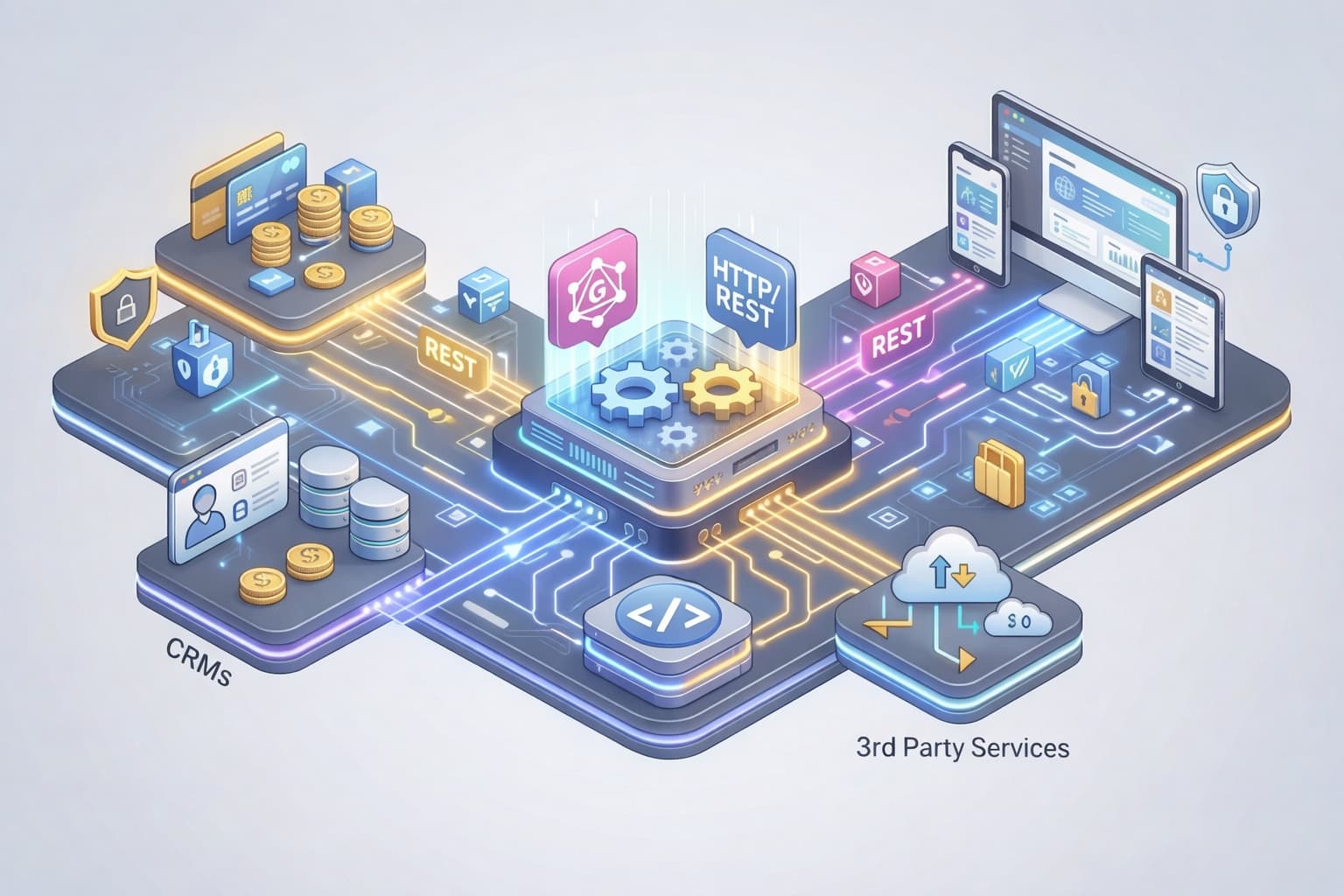
Modern applications are rarely standalone; they are ecosystems. Connecting Stripe, Salesforce, or Algolia directly from the client-side is a security risk and performance bottleneck. I architect a robust 'Backend-for-Frontend' (BFF) layer using Next.js API Routes and Node.js. This orchestration layer aggregates data, hides sensitive API keys, validates inputs, and ensures your frontend talks to one unified API, regardless of how many services are running in the background.
Integration Strategy
The BFF Pattern
Stop making 10 requests from the browser. I aggregate multiple endpoints (e.g., User Profile + Orders + Wishlist) into a single, efficient GraphQL or REST response, reducing latency and mobile data usage.
Secure Payments
Integration of Payment Gateways (Stripe, PayPal, Lemon Squeezy) requires strict security. I implement server-side handshake logic and webhook signature verification to prevent fraud and ensure transaction integrity.
Type-Safe Validation
Never trust external data. Using Zod or Valibot, I validate every incoming and outgoing payload. If a 3rd party API changes its format, my system catches it instantly before it breaks the UI.
Resilience & Error Handling
APIs fail. I implement retry logic, circuit breakers, and graceful degradation strategies. If the CRM is down, your checkout should still work. I ensure the user flow remains uninterrupted.
Local & Alternative Payments
Cards alone lose sales abroad. I integrate wallets and buy-now-pay-later (Apple Pay, Google Pay, Klarna) plus region-specific methods, with correct tax and VAT handling, so checkout matches how each market actually pays.
Shipping & Carrier APIs
I connect carrier APIs (UPS, FedEx, USPS, DHL) and aggregators like Shippo or EasyPost for live rates at checkout, label generation, and tracking webhooks, so fulfillment stops being a manual, error-prone step.
Integration Workflow
- 1
Mapping - Defining data contracts (OpenAPI/Swagger) between systems
- 2
Middleware - Setting up the Edge functions to proxy requests
- 3
Validation - Implementing Zod schemas for strict data typing
- 4
Webhooks - Configuring real-time event listeners (e.g., 'Payment Succeeded')
- 5
Monitoring - Logging API latency and errors via Datadog/Sentry
Integration Stack
What you have when it is done
Deliverables, not projections. Each one is something you can check on the day it is handed over.
- A backend-for-frontend layer, so no third-party key is ever shipped to the browser.
- Every external response validated at the boundary, with the expected shape written down.
- Defined behaviour for when a provider is slow or down, instead of an unhandled rejection.
Related Resources
Use this content path to evaluate implementation depth before we start your project.