Senior Frontend Architect, 10+ years building production Next.js applications. Contentful Certified Professional (2024). Specializes in React Server Components, headless commerce, and Core Web Vitals engineering.
React Server Components (RSC), introduced as an experimental RFC in December 2020 and stabilized in React 19 (December 2024), are the most significant architectural shift in React since hooks. RSC isn't an optimization layer bolted onto the existing model - it's a new rendering paradigm that redefines how components are composed, where data is fetched, and what actually gets shipped to the browser. This post covers: the rendering landscape RSC replaces, the component model and wire format, the practical patterns it enables - async components, Suspense streaming, Partial Prerendering - and a decision framework with real bundle-size benchmarks.
Part I - The Pre-RSC Rendering Taxonomy and Its Deficiencies
To appreciate what RSC actually changes, it helps to map the rendering landscape it replaces. Before RSC, React apps operated in four rendering modes, each a tradeoff along two axes: where HTML is generated (server vs. client) and when data is fetched (build time, request time, or client-side).
- CSR (Client-Side Rendering): HTML is a shell; the React application boots in the browser, fetches data via XHR/fetch, and renders entirely on the client. Implication: 100% of the JavaScript framework, component tree, and business logic is shipped to the client. The user sees a blank page until the JS bundle is parsed, compiled, and hydrated. TTI is directly proportional to bundle size.
- SSR (Server-Side Rendering): HTML is generated on the server per-request via
renderToStringorrenderToPipeableStream. The browser receives meaningful HTML immediately (good for FCP/LCP), but still must download the full React bundle and 'hydrate' - attaching event listeners to the server-rendered DOM. The JavaScript cost is identical to CSR; the perceived loading experience is better, the interactivity cost is not reduced. Shrinking that interactivity cost - the event-handler latency a user actually feels - is the substance of INP optimization in Next.js. - SSG (Static Site Generation): HTML is pre-rendered at build time. Zero server compute per request; maximum edge-cacheability. The limitation is data freshness - a product page rendered at build time cannot reflect live inventory without a rebuild or ISR.
- ISR (Incremental Static Regeneration): Next.js-specific extension of SSG. Pages are regenerated on a time- or demand-based schedule, allowing near-static delivery with controlled freshness. Still ships the full hydration bundle.
The common deficiency across all four modes: the client must receive, parse, compile, and execute the complete JavaScript representation of every component rendered on the page - regardless of whether that component requires any client-side interactivity. A navigation header that reads a database and renders static links ships the same JavaScript cost as a complex interactive form. RSC eliminates this by making the server/client split a first-class architectural primitive rather than a deployment-time choice.
Part II - The RSC Formal Model: RFC 188, Component Types, and the Wire Format
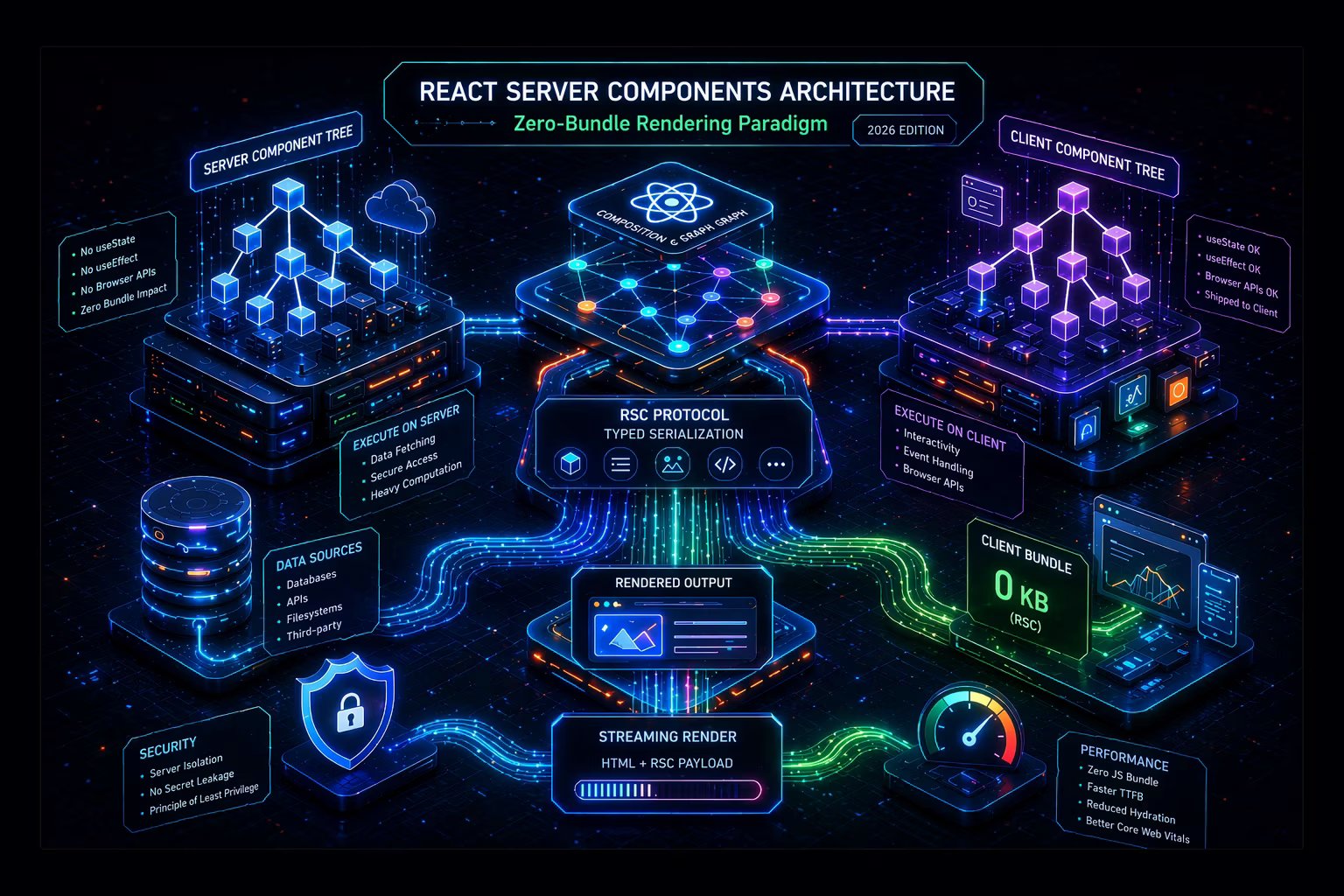
The RSC specification (React RFC #188, https://github.com/reactjs/rfcs/pull/188) defines two mutually exclusive component types within a single React tree: Server Components and Client Components. The classification is determined at module level, not at runtime - making it a static property of the codebase, verifiable by the bundler.
A Server Component is any React component that does not contain the 'use client' directive at the top of its module file. Server Components execute exclusively in the server environment. They may be async functions, they may await database queries or filesystem reads directly in their render body, and they contribute zero bytes to the client JavaScript bundle. Their output is not HTML and not a VDOM tree - it is a serialized payload in the RSC wire format, a JSON-like protocol that encodes React element trees including references to Client Components as opaque module specifiers.
A Client Component is any component whose module begins with the 'use client' directive. This directive marks a module boundary - the 'client boundary' - below which all transitive imports are also treated as client-side code. Client Components are included in the JavaScript bundle sent to the browser, support state (useState), effects (useEffect), browser APIs, and event handlers. They are the continuation of the classic React component model.
The critical insight, and the most common source of architectural confusion, is that 'use client' is a boundary declaration, not a description of where a component renders. Client Components are still rendered on the server during SSR to produce the initial HTML payload - the directive means 'this component and its subtree are also hydrated and re-rendered on the client.' Server Components are never re-rendered on the client, ever. Their output is static within a given request.
- RSC wire format: Transmitted as a streaming JSON-like text stream (Content-Type: text/x-component). Each line is a React element descriptor: element type (string for DOM, module reference for Client Components), props, and children. Server Component output is inlined as JSON; Client Components are referenced by module ID, resolved against the client bundle's chunk manifest.
- Serialization constraint: Props crossing the server/client boundary must be serializable - primitives, plain objects, arrays, Dates, Maps, Sets, Promises. Non-serializable values (functions, class instances, DOM nodes) cannot be passed as props from a Server to a Client Component. This is enforced at runtime in development and by static analysis tooling.
- React Flight protocol: The internal name for the RSC streaming protocol. It supports out-of-order chunk delivery - a Server Component with a slow async operation does not block faster siblings, because each component's output is streamed as an independent chunk, resolved by the React runtime on the client as chunks arrive.
The Composition Model: Interleaving Server and Client Subtrees
The composition model of RSC is counterintuitive until its underlying constraint is understood: a Server Component cannot import a Client Component as a child in its JSX if that import would cause the client bundle to include the Server Component module. However, a Server Component can pass a Client Component as a prop (specifically as children or any JSX prop), and a Client Component can render its children prop - which may be a Server Component subtree. This is the 'donut' pattern: a Client Component shell with a Server Component interior.
Concretely: <ClientShell><ServerContent /></ClientShell> is valid. The ClientShell component is a Client Component that wraps its children prop. ServerContent is a Server Component that remains on the server. The ClientShell module is bundled for the client; the ServerContent module is not. The RSC wire format carries the rendered output of ServerContent as an already-resolved subtree within the ClientShell's props - the client never sees the source code of ServerContent, only its output.
This composition rule has profound implications for library design. A component library that wraps everything in 'use client' forces every consumer to include that library in their bundle. A library that carefully places 'use client' only at leaf interactive components (buttons, inputs, modals) allows its purely presentational components (typography, layout, containers) to be used as Server Components - shipping zero JavaScript for those subtrees.
Part III - Async Components and the Data Fetching Architecture
Prior to RSC, data fetching in React was a client-side concern mediated by useEffect, SWR, React Query, or Next.js's getServerSideProps/getStaticProps functions. Each model introduced one of two problems: either data was fetched on the client (costing an additional round-trip after hydration), or data was fetched in a special page-level function that could not be collocated with the component that consumed it.
RSC resolves this by making Server Components async functions. An RSC may directly await any asynchronous operation - a Prisma/Drizzle ORM query, a fetch() call to an internal API, a filesystem read via fs.readFile - in its render body. The React runtime awaits the component's Promise before streaming its output. This is not a workaround; it is the intended model, formalized in RFC 188 and implemented as async function Component() in React 19.
- Waterfall prevention via parallel fetch: Multiple sibling async Server Components can be rendered in parallel by the server runtime. Each component independently suspends, allowing the runtime to proceed with components that resolve first. The key pattern is to initiate all Promises before any
await-const [a, b] = await Promise.all([fetchA(), fetchB()])- within a single component to colocate related data fetches without introducing artificial sequencing. - Cache deduplication: Next.js wraps
fetch()calls within a single render pass with automatic deduplication - identical URL + options combinations within the same request are coalesced into a single network call. This allows multiple components in the tree to independently callfetch('/api/user')without incurring N network requests. - The request/response model: In the Next.js App Router, each RSC render is associated with a request context accessible via
headers(),cookies(), andparams. This replacesgetServerSideProps'scontextargument and allows any component in the tree - not just the page root - to access request-time data.
Suspense, Streaming, and the Progressive Rendering Protocol
React's Suspense component integrates natively with async Server Components. When a Server Component awaits an operation that has not yet resolved, React suspends that subtree and renders the nearest <Suspense fallback={...}> boundary instead. As the Promise resolves, the completed subtree is streamed to the client as a new RSC payload chunk and React hydrates it in place, replacing the fallback.
The HTTP transport for this streaming is HTTP/1.1 chunked transfer encoding or HTTP/2 multiplexed streams. The server begins sending the HTML document immediately upon receiving the request. Static shell content (navigation, layout, above-the-fold structure) arrives in the first chunk, potentially within 50–100ms of the request. Dynamic data-dependent components stream in subsequent chunks as their Promises resolve, each chunk injected into the correct position in the DOM via inline <script> tags that call React's internal $RC (Relay Chunk) function.
The observable LCP implication: a product page can stream its static shell in the first response chunk, achieving a sub-200ms FCP, while the dynamic content - reviews, inventory count, personalized recommendations - streams in subsequent Suspense chunks without blocking the LCP element. This is architecturally distinct from traditional SSR, where renderToString blocks the entire response until every component in the tree has resolved. Next.js turns exactly this static-shell-plus-streaming-holes pattern into a production rendering mode called Partial Prerendering - see Partial Prerendering in production.
Partial Prerendering: The Unified Static/Dynamic Model
Partial Prerendering (PPR), stabilized in Next.js 15, extends the RSC streaming model to the CDN layer. PPR pre-renders the static shell of each page at build time and caches it at the edge. On each request, the CDN serves the cached static shell immediately (zero server compute, near-zero TTFB) while the dynamic RSC holes - wrapped in <Suspense> boundaries - are streamed from the origin server. The browser receives a response in two logical parts: the cached static structure and the streamed dynamic content, multiplexed over the same HTTP/2 connection.
PPR treats the React tree as a graph where nodes are either statically deterministic (their output depends only on build-time data) or dynamically dependent (their output depends on request-time data - headers, cookies, database state). Static nodes are pre-rendered and cached; dynamic nodes are rendered per-request. The boundary between the two is the <Suspense> component. The Vercel team's 2025 PPR benchmark reports a 40–65% reduction in TTFB on pages previously rendered entirely server-side.
Part IV - Empirical Impact: Bundle Size and Performance Benchmarks
- facebook.com internal migration (React Conf 2024): Converting a data-display component tree from Client to Server Components reduced the client JavaScript bundle for that tree by 78%. ~120 KB of component logic, data fetching code, and formatting utilities were eliminated from the client bundle. Only the rendered output (~8 KB RSC payload) was transmitted.
- Shopify Hydrogen 2 (October 2024): Converting the product detail page from CSR+RSC hybrid to primarily RSC reduced per-page JavaScript from 340 KB to 89 KB. TTI on a simulated Moto G Power improved from 4.2s to 1.8s. Source: Shopify Engineering Blog.
- Vercel Commerce template (January 2025): The reference eCommerce template built entirely with App Router RSC ships 67 KB of initial JavaScript versus 210 KB for the equivalent Pages Router implementation - a 68% reduction. Source: Vercel blog.
- HTTP Archive 2025 Web Almanac: Sites using Next.js App Router show a median JavaScript bundle weight of 180 KB versus 390 KB for Pages Router sites of equivalent functionality - a 210 KB difference aligned with the theoretical RSC zero-bundle prediction.
The React 19 Compiler: RSC Synergy and Auto-Memoization
The React 19 Compiler is a build-time transformation that automatically inserts memoization - the equivalent of useMemo, useCallback, and React.memo - wherever the compiler can prove it is safe and beneficial. The compiler operates exclusively on Client Components (Server Components have no memoization concern because they never re-render on the client).
The RSC+Compiler interaction is synergistic: RSC reduces the volume of code that runs on the client by eliminating entire component subtrees from the bundle; the Compiler reduces the frequency of re-renders within the Client Components that remain. A well-structured RSC application might have 60–70% of its component tree as Server Components (zero re-render cost) and 30–40% as Client Components (Compiler-optimized). Per the React team's benchmarks (React Conf 2024): enabling the Compiler on a production application that was already well-memoized by hand reduced re-renders by an additional 22% - manual memoization, even by experienced engineers, leaves significant optimization unrealized.
Common Misuse Patterns and Architectural Anti-Patterns
- Overuse of
'use client': The most prevalent anti-pattern. Adding'use client'to every component effectively reverts to the Pages Router model. The correct default: every component is a Server Component unless it explicitly requires state, effects, or browser APIs. - Prop drilling across boundaries: Colocate the data fetch at the deepest Server Component that needs it - RSC makes this cheap because each async Server Component fetches independently with Next.js's automatic deduplication.
- Treating RSC as a mutation mechanism: RSC is the correct tool for read-heavy, render-time data. Mutations remain the domain of Server Actions (
'use server'), React Query, or SWR. - Large serialized props: Passing a 500-item product catalog as a JSON prop from a Server Component to a Client Component ships all 500 items in the RSC wire format. Paginate or filter server-side before the boundary crossing.
- Missing Suspense boundaries: An async Server Component without a wrapping
<Suspense>will block the entire page response until it resolves. Every async Server Component should be wrapped in<Suspense fallback={<Skeleton />}>.
The Architecture Decision Framework: Server vs. Client Component
- Uses
useState,useReducer, oruseContext? → Client Component. Server Components have no per-render state. - Uses
useEffect,useLayoutEffect, oruseInsertionEffect? → Client Component. Effects are browser-lifecycle callbacks. - Attaches DOM event listeners (
onClick,onChange,onSubmit)? → Client Component. Event handlers are functions - not serializable across the RSC wire format. - Accesses browser APIs (
window,document,navigator,localStorage,IntersectionObserver)? → Client Component. These APIs do not exist in the server Node.js environment. - Imports a library that has any of the above in its module graph? → Client Component, or restructure to hoist the library call to a leaf Client Component.
- None of the above? → Server Component. Fetch data directly, render output, contribute zero bytes to the client bundle.
The target architecture: Client Components are leaf nodes - the smallest possible boundary around interactive behavior - and Server Components form the structural majority of the tree.
Case Study: eCommerce Product Detail Page Architecture
- Page root (Server Component, async): Fetches product data. Renders static product structure - images, title, description. PPR-cacheable at the edge because it depends only on
params.slug. <PriceBlock productId={id} />(Server Component, async, Suspense-wrapped): Fetches user-specific pricing with user ID from cookies. Streams independently. Zero bytes in client bundle.<InventoryBadge productId={id} />(Server Component, async, Suspense-wrapped): Fetches live inventory. Streams independently of pricing fetch.<AddToCartButton productId={id} price={price} />(Client Component): Manages cart state viauseState, calls a Server Action on submit. The only'use client'boundary in this entire page tree.<RecommendationCarousel userId={userId} />(Server Component, async, Suspense-wrapped): Fetches ML recommendations server-side, renders a static carousel.
Result: a product detail page shipping approximately 40–60 KB of client JavaScript (the Add to Cart button and its framework cost) rather than the 300–500 KB typical of a CSR/SSR hybrid. LCP streams in the first response chunk. Personalized data streams in parallel Suspense chunks without blocking the LCP. INP on the Add to Cart interaction is unaffected by the complexity of the rest of the page - because those components are not in the client bundle.
Server Actions: The Mutation Complement to RSC
Server Actions ('use server' directive on a function) are the read/write complement to RSC's read-only model. A Server Action executes on the server but can be called from a Client Component as a regular JavaScript function invocation - the framework handles serialization, transport (HTTP POST to a generated endpoint), and response cycle transparently.
The RSC + Server Actions model creates a full-stack component architecture where data reading and data writing are both expressible as React primitives without a manually-maintained API layer. revalidatePath() and revalidateTag(), called from within a Server Action, trigger RSC re-renders on specific routes after a mutation - closing the read/write loop without client-side state management.
Conclusion: RSC as a Paradigm Shift, Not an Optimization
RSC isn't a performance optimization in the conventional sense. It changes the question from 'how do I make my JavaScript faster?' to 'how do I make sure only the JavaScript that genuinely needs to run on the client gets shipped there at all?' The numbers back this up: 68–78% bundle reductions in production migrations, sub-2s TTI on mid-range devices, 40–65% TTFB reductions with PPR. Combined with the React 19 Compiler and Next.js 15 Partial Prerendering, you get performance characteristics approaching static HTML for most of the page - with full React interactivity only where you actually need it.
For production architecture reviews or App Router migration strategy, frontend architecture consulting and eCommerce performance optimization services are available - see case studies for real migration benchmarks or discuss your project.
References
- Abramov, D., Dodds, K., et al. React RFC #188 - React Server Components (December 2020)
- React Team. React 19 Release Notes (December 2024)
- React Team. React Server Components - Official Documentation
- Next.js Team. App Router Architecture Documentation
- Next.js Team. Partial Prerendering Documentation
- Vercel Engineering. 'Partial Prerendering: Making your app as fast as static HTML' (2025)
- Shopify Engineering. 'Hydrogen 2: RSC Migration Benchmarks' (October 2024)
- HTTP Archive 2025 Web Almanac, JavaScript chapter
- React Conf 2024 - React Compiler deep-dive (Sophie Alpert, Joe Savona)
- Osmani, A. 'Patterns for Building React Applications' (2024, updated 2025)
- W3C React Working Group - RSC and Web Standards