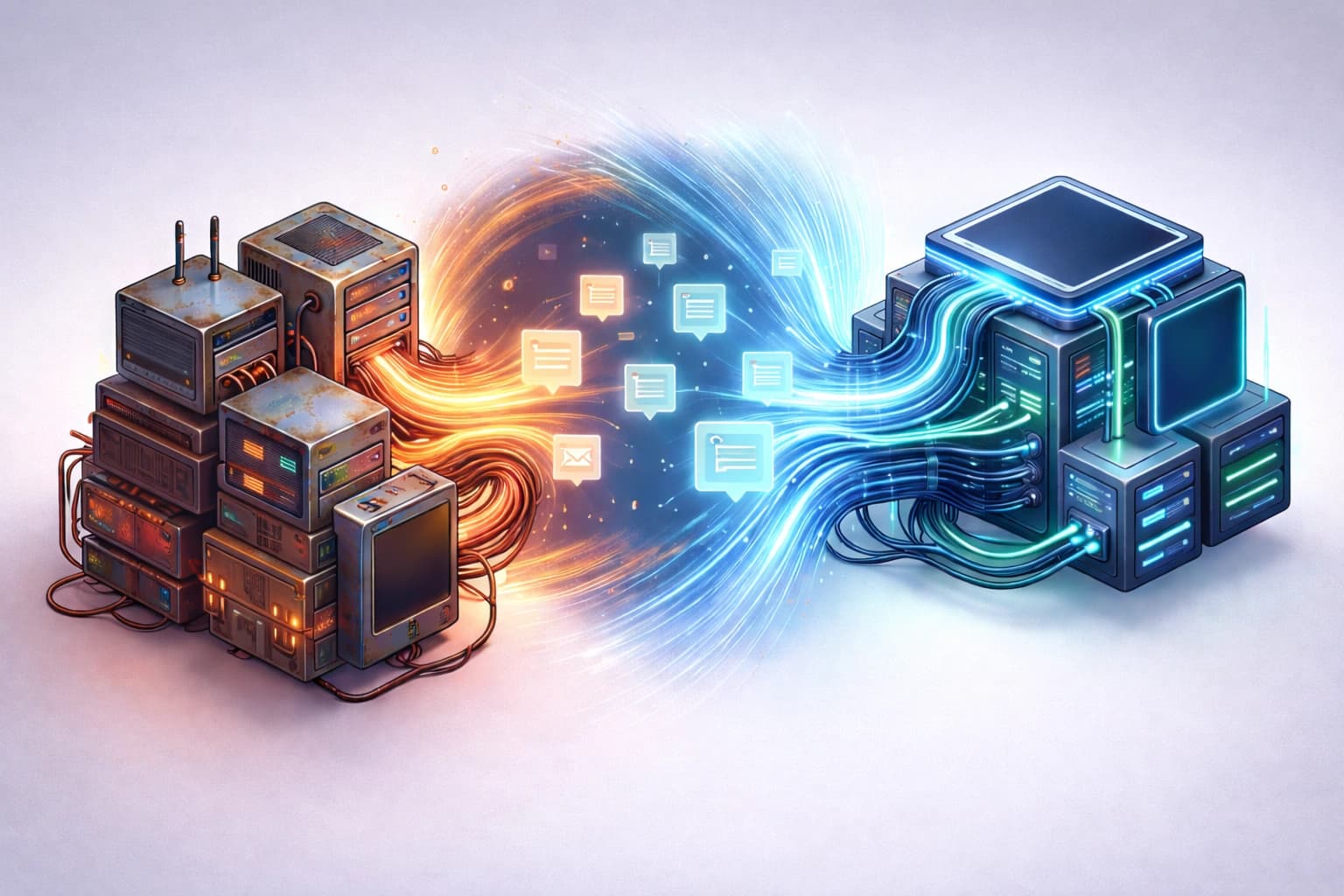
Legacy monolithic architectures often combine robust backends with outdated, slow frontend templates. I specialize in separating these layers. By introducing Node.js as a modern rendering environment, we migrate your user interface from synchronous server-side templates (PHP/JSP) to a high-performance, asynchronous Next.js application, keeping your existing backend data secure while unlocking modern UX.
Modernization Strategy
Decoupling the Frontend
We stop using your legacy backend for HTML generation. Instead, we implement a Node.js middleware that fetches data and renders it via Next.js 16, providing instant page loads.
Incremental Migration
Using the 'Strangler Fig' pattern, we replace pages one by one (e.g., Checkout first, then Catalog). You don't need to rewrite the whole system at once; the old and new sites run in parallel.
Solving the Talent Gap
It is hard to find developers for old proprietary template engines. Modernizing to React and TypeScript opens access to a vast talent pool and speeds up feature development.
Technical Debt Elimination
We replace unmaintainable 'spaghetti code' (jQuery/Vanilla JS) with typed, component-based React 19 logic, ensuring stability and easier long-term maintenance.
Migration Roadmap
- 1
Audit - Analyzing legacy dependencies and tight coupling points
- 2
BFF Setup - Deploying Node.js as a Backend-for-Frontend layer
- 3
Component Build - Recreating UI elements in React with modern accessibility standards
- 4
Routing - Configuring Edge Middleware to serve new Next.js pages
- 5
Sunset - Decommissioning the legacy template engine completely
Migration Stack
What you have when it is done
Deliverables, not projections. Each one is something you can check on the day it is handed over.
- The legacy frontend still serving, with routes moved across one at a time behind a reverse proxy.
- A rollback path for every migrated route, tested before that route takes live traffic.
- A codebase you can hire a React developer for.
Related Resources
Use this content path to evaluate implementation depth before we start your project.